




Distributors aren’t able to carry all the products a given manufacturer offers. So when market demand comes calling for something they don’t have in stock, they may be tempted to rework the products they do have on hand to fit the need. The problem is they lack the expertise to account for every scenario or really to understand what went into the manufacturing process to begin with, and the result more often than not is serious quality issues.
For instance, in the past, it was commonplace for distributors to zinc plate nails and large diameter bolts together to save on plating costs. What these distributors found, however, was that this strategy was likely to cause damage to products as nail points became dull and were often being bent by the large bolts – potentially costing them not only money but customers as well.
Recently we’ve seen an increase in this type of reprocessing on rivets, which can be risky. There are certain products in particular where distributors should take extreme care, and even consider eliminating any internal reprocessing such as plating, waxing and painting even if performed by approved suppliers.
Rivets Using Engineered Wax
Take semi-tubular rivets, structural blind rivets and rivet nuts as an example. These products contain engineered wax that should never be reprocessed. That’s because even the best platers don’t commonly stock these top-notch engineered waxes. Commercial platers generally think of paraffin-based wax as a one size fits all lubricant, but manufacturers actually formulate or specify their own wax and wax processes. Some of these waxes are PTFE fortified liquid while others are PTFE lubricant solids in a liquid suspension. Others still have UV tracers in them to ensure proper coverage. There’s a specific recipe for every product produced with wax that manufacturers guard closely as it provides a functional advantage over other manufacturers. They consider how much wax should be applied, how it’s applied, how much water and what type of water should be used as well as what additives, ratios, heat and drying methods should be used. Perhaps most importantly, they also define how long a wax fluid should be used before it is removed from the tank. These formulations are developed based on the manufacturer’s expertise and understanding of how the rivet will be used, and each has its own distinct advantages. Some function better than others in automation equipment while others work with certain anvils/tools, for instance. Conversely, there are also products where no wax should be applied – and if it is reprocessed, the rivet will not work.
Assembled, Two-Piece Blind Rivets
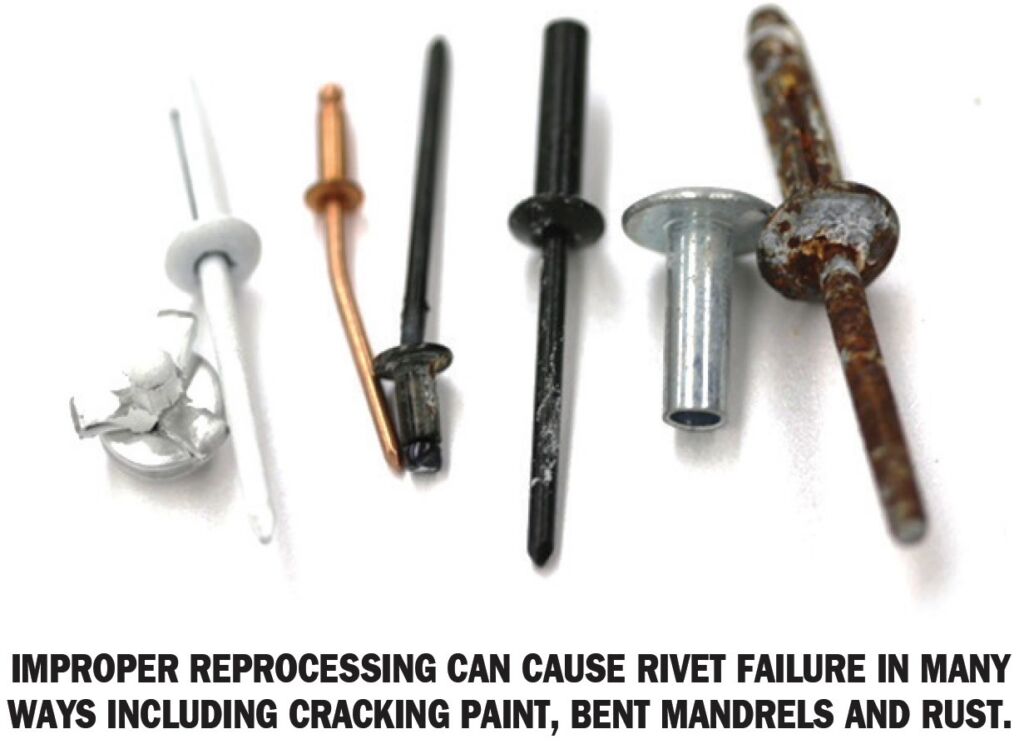
Another key product to be aware of is blind rivets. Blind rivets should not be replated at all because they are assembled, two-piece components. The plating process involves an acid bath followed by an electroplating bath. If this is applied to blind rivets in their assembled condition, the air released from the acids could cause the chemicals to become stationary in between the mandrel and the rivet body. Although the end product may look like a good rivet upon their return, it will rust over time. Other potential failures include bent mandrels or a rivet body that separates from its mandrel. Any of these scenarios will make the rivets unrepairable and unusable, potentially resulting in your having to throw away stock, which is basically throwing away money.
As you can see, it is best to consult with your manufacturer and have them provide the specific finish you need. They can ensure plating, wax or paint is applied to their specifications and before rivets are assembled – saving much wasted time, money and aggravation caused by unnecessary quality issues. They can also ensure the final product is tested in accordance with IFI requirements before the finished product is shipped.
If your manufacturer doesn’t already have a product in stock that meets your needs, they can often quickly produce it based on their deep experience and inventory of sub-components.
The result is a win-win-win for the customer, distributor and manufacturer.
Originally published in Distributor’s Link Magazine, Spring 2018. Written by Steven Sherman, Vice President, Industrial Rivet & Fastener Co.