




As manufacturing continues to trend toward thinner, lighter materials — including soft sheet metals, hardened aluminum skins, plastics, composites, and carbon fiber — engineers and designers are increasingly turning to rivet nuts as the fastening solution of choice. But what exactly makes rivet nuts the right fit for certain applications, and when do they outperform conventional alternatives?
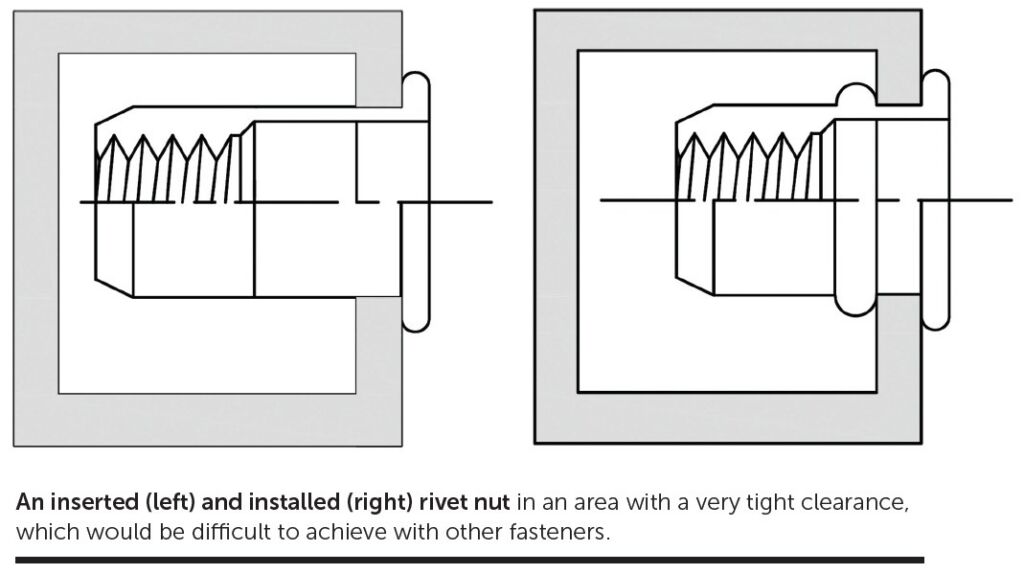
Rivet nuts are internally threaded fasteners that install from just one side of a workpiece, making them ideal for blind applications where access to the back of the material isn’t possible. Beyond that core advantage, they offer a range of performance benefits that make them superior to many conventional fastening methods in demanding assemblies.
The Challenge of Fastening Thin Materials
Joining thin materials with conventional threaded fasteners is one of the more persistent challenges in manufacturing. When a bolt threads into thin sheet metal, there’s simply not enough material depth to create a strong, secure attachment. Fastener pull-out strength — the force required to tear a fastener out of an application — becomes a critical concern, and standard bolts and screws often fall short.
Alternative solutions exist, including clinch nuts, u-nuts, and weld nuts, but each comes with its own set of limitations. Most notably, these options require access to both sides of the material, which isn’t always feasible in real-world assembly environments.
Rivet nuts solve both problems at once — they install from one side and create a strong, permanent threaded connection that resists pull-out forces effectively even in thin or soft substrates.
Five Key Advantages of Rivet Nuts
1. Permanently affixed connection Once installed, a rivet nut forms a connection that is substantially stronger than most alternative joining technologies in thin sheet metal applications. The single-sided installation process, combined with a lower total installed cost and greater assembly convenience, makes rivet nuts a highly practical choice. They also resist applied forces in multiple directions and are extremely difficult to remove once set — a critical advantage in safety-sensitive applications.
2. Substantial bolt and screw thread engagement In thin materials, tapping screws and thread-forming fasteners have limited contact with the radial wall, reducing their holding strength. Rivet nuts address this directly by providing full thread engagement along with a reliable bearing surface area and strong clamp force. This combination significantly improves pull-out resistance compared to screws or bolts used alone in thin substrates.
3. Radial hole fill for vibration resistance Unlike a screw or bolt that simply passes through a hole, rivet nuts radially swell to fill the hole during installation. This swelling action locks the fastener in place and prevents the substrate from weakening over time due to vibration — a common failure mode in automotive, HVAC, and industrial equipment applications. Maintaining the rigidity of joined materials is essential to long-term joint strength, and rivet nuts deliver this in a way that bolts alone cannot.
4. Unique design for joining dissimilar materials One of the most underappreciated advantages of rivet nuts is their ability to join dissimilar materials — for example, plastic panels mounted to a steel frame. The head and body design of a rivet nut increases both pull-out and torque-out resistance when materials with different properties are combined. Torque-out refers to the rotational force needed to spin a fastener out of an application rather than pull it straight out.
With rivet nuts, engineers can independently select the ideal clamp load for each material in the assembly. For instance, a softer clamp force appropriate for a plastic component can be used on one side, while a higher-strength Grade 5 bolt provides the necessary holding power for the steel frame on the other — something that’s not possible with conventional fastening approaches.
5. Wide blind-side bearing surfaces for soft or thin materials Rivet nuts function by generating a controlled bulge on the blind side of the bearing surface during installation. In most applications with appropriate material strength and hole sizing, this bulge provides more than enough pull-out resistance. In particularly thin or soft materials, however, additional design features are available to maximize performance.
Specialized rivet nut designs include bulge-control features that spread the blind-side expansion over a broader surface area, reducing concentrated stress on weak materials. Four-wing versions work similarly to a molly bolt, distributing the installation bulge across four contact points to dramatically improve pull-out performance. These design options make rivet nuts effective even in the softest and thinnest substrates used in modern manufacturing.
Choosing the Right Rivet Nut
With so many design variations available — open end, closed end, knurled body, round body, hex body, flat head, countersunk head, and more — selecting the right rivet nut for a specific application requires a clear understanding of the joint requirements, material properties, hole size, and load conditions.
Industrial Rivet & Fastener Co. has been helping engineers and fastener distributors navigate these decisions for over 110 years. Our team offers application engineering support, onsite and lab-based testing with load cells, and one of the industry’s largest inventories of rivet nuts in a wide range of materials, sizes, and configurations.
For more information about rivet nuts and the full RivetKing® fastener product line, visit rivet.com or email marketing@rivet.com.
Originally published in Fastener Engineering Magazine, December 2020.